
SEO is a Lie
/ 5 min read
Table of Contents
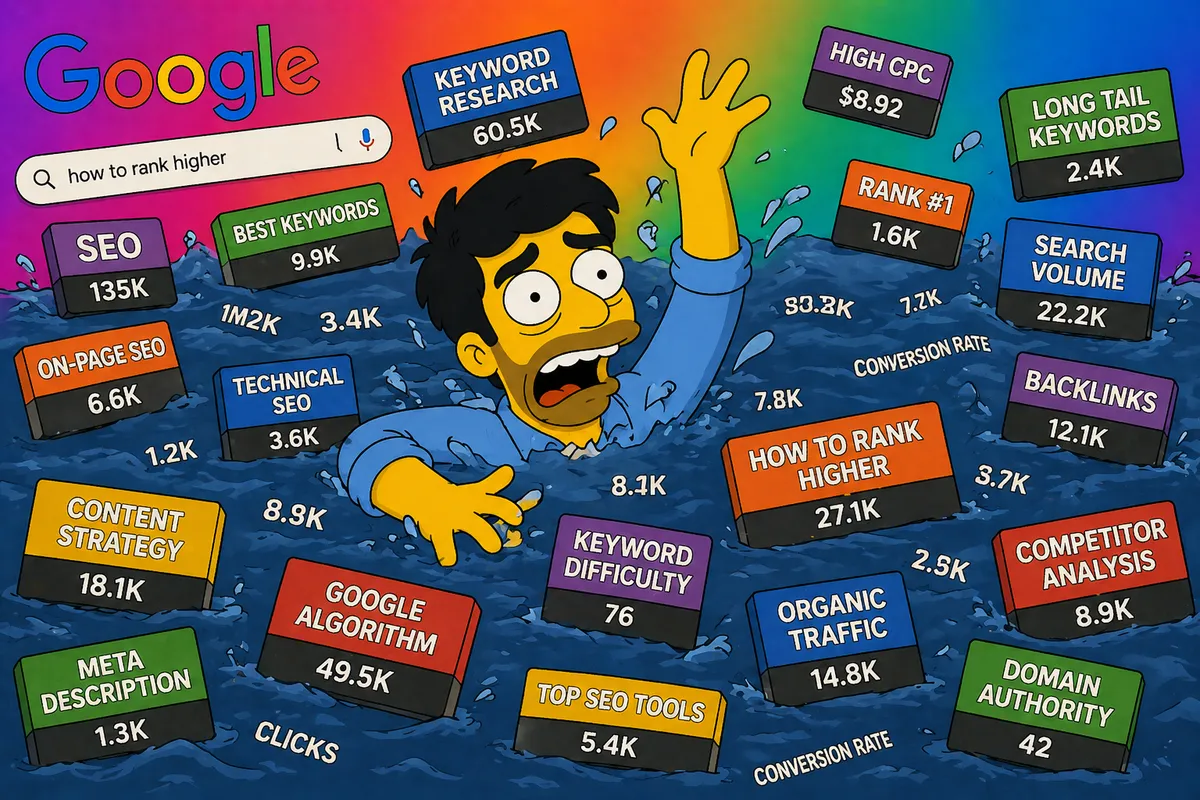
Nobody tells you that SEO is mostly waiting.
You do the research. Build the structure. Write the content. Fix the technical issues. Create the backlinks. Follow every rule in every guide ever written about search engine optimization. Then you sit back and wait for Google to notice.
Sometimes it does. Sometimes it doesn’t. Sometimes it notices three months later for reasons you’ll never fully understand.
That’s the lie. Not that SEO doesn’t work. It does. But it works on its own schedule, by its own logic, and no amount of expertise fully tames it. You do the research. Build the structure. Write the content. Fix the technical issues. Create the backlinks. Follow every rule in every guide ever written about search engine optimization. Then you sit back and wait for Google to notice.
Sometimes it does. Sometimes it doesn’t. Sometimes it notices three months later for reasons you’ll never fully understand.
That’s the lie. Not that SEO doesn’t work. It does. But it works on its own schedule, by its own logic, and no amount of expertise fully tames it.
I learned this at one of the more serious digital agencies I’ve worked at. Professional operation. Years of experience in the room. US based and MENA region clients on yearly retainers. People who knew exactly what they were doing.
And still — half of it was educated guessing.
What I Was Actually Doing
My role was off-page SEO. Specifically backlink building — the unglamorous, methodical work of reaching out to websites, pitching guest posts, securing article listings, and slowly building the kind of link profile that tells Google a website is worth trusting.
It sounds straightforward. It isn’t.
Every outreach email is a cold pitch to a stranger asking for something with limited incentive to say yes. Sound familiar? Turns out cold calling and link building have more in common than anyone admits. You’re still just trying to make someone who doesn’t know you care enough to respond.
Alongside the outreach I was doing keyword research, technical audits, and writing SEO optimized content. Not the keyword stuffing kind — that stopped working years ago and anyone still doing it deserves the penalty. The real kind. Where relevancy, structure, and genuine usefulness do the heavy lifting.
The Waterfall
The most useful thing I learned there wasn’t a tool or a technique. It was a way of thinking.
Before writing anything I’d skim through hundreds of similar articles on the same topic. Not to copy them. To find what they all missed. The gap. The angle nobody had taken. The question readers were clearly asking that nobody was clearly answering.
Fill that gap and you don’t need tricks. You just need to be the most useful result on the page.
It sounds simple. It takes longer than you’d expect. Most content skips this step entirely and then wonders why it doesn’t rank.
Brian Dean built an entire methodology around this — the Skyscraper Technique. Find what exists, build something better, promote it to the right people. The principle is the same. The execution is just patience and research applied consistently.
Ahrefs and the Illusion of Control
Ahrefs gives you data. Lots of it. Domain ratings, keyword difficulty scores, traffic estimates, backlink profiles. It feels like control because the numbers are specific and the dashboards are clean.
But here’s what the dashboard doesn’t tell you.
Google updates its algorithm constantly. A page ranking comfortably at position three today can disappear to page four tomorrow because of a core update nobody saw coming. Your carefully researched keyword cluster can underperform because user intent shifted slightly in a direction the data didn’t predict.
You learn to read the numbers. You also learn not to trust them completely. The best SEO professionals hold their data confidently and their conclusions loosely. They know the difference between a signal and a certainty.
That distinction — between what the data says and what will actually happen — is something I’ve carried into every analytical role since.
Why Four Months
Maple Leaf Cement came calling. Assistant Manager of Marketing at one of Pakistan’s largest industrial companies.
That’s not a lateral move. That’s a different league entirely.
I wasn’t running from SEO. I was running toward scale. The agency taught me digital precision — keyword clustering, content structure, technical auditing, backlink strategy. The cement company would teach me something the agency never could — what marketing looks like when the stakes are genuinely industrial and the brand has been built over decades.
You take that call. Every time.
What SEO Actually Teaches You
SEO is a long game dressed up as a technical discipline.
It teaches you that visibility requires consistency — not brilliance, not luck, but showing up with the right answer to the right question at the right time repeatedly until the algorithm trusts you enough to show your work to strangers.
It teaches you that gaps are opportunities. Every overcrowded topic has an angle nobody has taken. Finding it requires patience, research, and the willingness to read hundreds of articles looking for the one thing they all missed.
And it teaches you that you can do everything correctly and still wait. Still sit in silence watching a ranking that refuses to move. Still trust the process even when the process isn’t showing its work.
That kind of patience — disciplined, research backed, unglamorous — turns out to be useful everywhere.
Not just in search engines.
SEO doesn’t lie exactly. It just doesn’t tell you when.