
Spam is Just Unrequited Love
/ 5 min read
Table of Contents
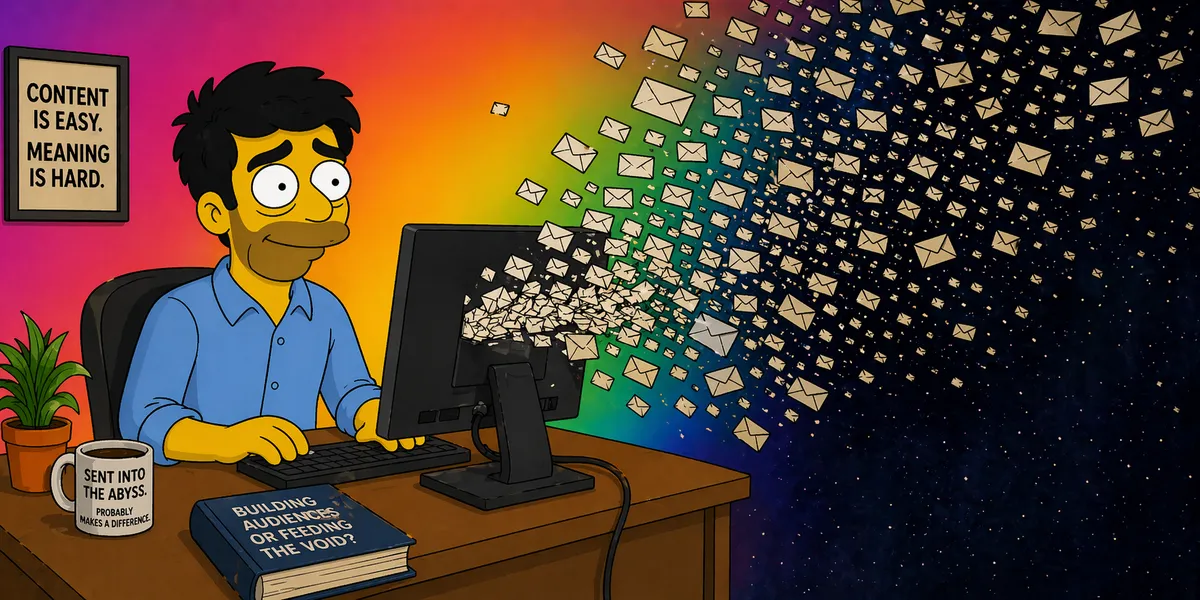
Every day I sent emails to people who didn’t know I existed. Thousands of them. Sometimes tens of thousands. Carefully crafted subject lines. Optimized send times. Warmed up domains. The whole operation running like a quiet, invisible machine — reaching into inboxes across cities, countries, and time zones with offers people may or may not have wanted.
Nobody replied saying thank you.
Most didn’t reply at all.
That’s email marketing. And for nine months it was my entire professional world.
The Machine Behind the Message
The company ran a serious operation. Campaigns ranging from ten thousand to a hundred thousand emails. Retail clients across multiple markets. A proprietary sending platform built specifically for volume. GDPR compliant. CAN-SPAM compliant. Every list segmented by city, by country, by region.
Legal. Structured. Scaled.
What it wasn’t was flexible. Creativity had boundaries here. The system had a logic and the logic was volume. You learned quickly that your job wasn’t to reinvent email marketing. It was to make the machine run smoothly and keep the numbers healthy.
I made peace with that somewhere around week four.
Week two and three were harder.
The Feeling Nobody Talks About
There’s a specific discomfort that comes with mass email work that nobody in the industry openly discusses.
You’re reaching people who didn’t specifically ask to hear from you today. About this product. In this way. Even with every compliance box ticked — and ours were — you’re still an interruption. A stranger showing up in a personal space with something to say.
It crept up on me early. That quiet ethical unease of sitting inside a machine that was technically legal but felt — on certain days, with certain campaigns — like shouting into a crowd and hoping someone shouted back.
Seth Godin called this interruption marketing decades ago. The old model. Broadcast first, ask questions never. His argument for permission marketing — earning attention rather than buying it — made more sense to me with every campaign I sent.
But here’s what I also learned. The discomfort was useful. It made me better at the craft. Because the only way to quiet that feeling was to make the emails genuinely worth opening.
What Actually Makes Someone Open an Email
This is the question every email marketer obsesses over and nobody fully answers because the honest answer is — it depends and it changes.
But one thing stays constant.
Surprise them. Give them something valuable — information, learning, a promotion, a reason to care. Create urgency if it’s real. Never manufacture it if it isn’t. And above everything else — don’t be clickbait. The subject line is a promise. The email is whether you kept it.
People don’t open emails because of clever wordplay. They open emails because something in that subject line made them think “this might be worth thirty seconds of my life.” Your entire job is to earn that thirty seconds honestly.
Cialdini’s influence principles live inside every good email whether the writer knows it or not. Reciprocity — give something before asking. Scarcity — but only when it’s real. Social proof — show them others found this valuable. These aren’t manipulation tactics. They’re just how humans respond to information when it feels relevant to their lives.
The Technical Education Nobody Advertises
Beyond the philosophy there was genuine craft being practiced here daily.
Domain warming — the slow, deliberate process of building sender reputation before running large campaigns. Rush it and your domain gets flagged. Patience it and your emails land in inboxes instead of spam folders. There’s an entire science to it that most marketers never learn because most marketers never work at this volume.
Deliverability monitoring. Watching campaigns in real time. Knowing when to pause, when to switch domains, when to pull back before a ban. It’s less glamorous than copywriting but it’s the difference between a campaign that reaches people and one that disappears into a digital void.
HTML email templates built from scratch. Not Canva. Not drag and drop builders. Actual code — because proprietary platforms require it and because understanding the structure makes you faster and more precise than anyone working from templates.
Mailchimp. MooSend. Custom platforms. Each with different logic, different quirks, different ways of handling the same problem.
I learned all of it in nine months. Not because the environment encouraged growth — it didn’t particularly — but because the work demanded technical depth and I was curious enough to go looking for it.
Why I Left
The office was good. The people were educated, capable, genuinely skilled at what they did. There was nothing wrong with the place on its own terms.
But its terms weren’t mine anymore.
An MBA in marketing is a promise you make to yourself — that you won’t stop at one channel, one skill, one ceiling. I had learned email deeply. Technically, strategically, psychologically. The next thing to learn wasn’t here.
So I left. Not dramatically. Not unhappily. Just deliberately.
The machine kept running without me. As machines do.
Spam is just unrequited love — you put everything into something and hope, quietly, that someone on the other end feels it too. Sometimes they do. Most times they don’t. You send anyway.